Over the past few years, people have started acknowledging the presence of anxiety and naturally, the measures to control and manage anxiety have taken a significant importance.
Anxiety is a state of your mind, it’s a mental thing, right? Physically, there are a couple of things you do that directly or indirectly help manage anxiety like planning your day, exercising, reducing alcohol consumption or smoking, etc. However, to impact your mental well-being on a stronger level, you need to tackle your emotions and introspect your feelings. Basically, observe what happens when you give your mental state, the rest that it needs. Some ways include meditation, deep breathing exercises, being in a state of mindfulness, etc.
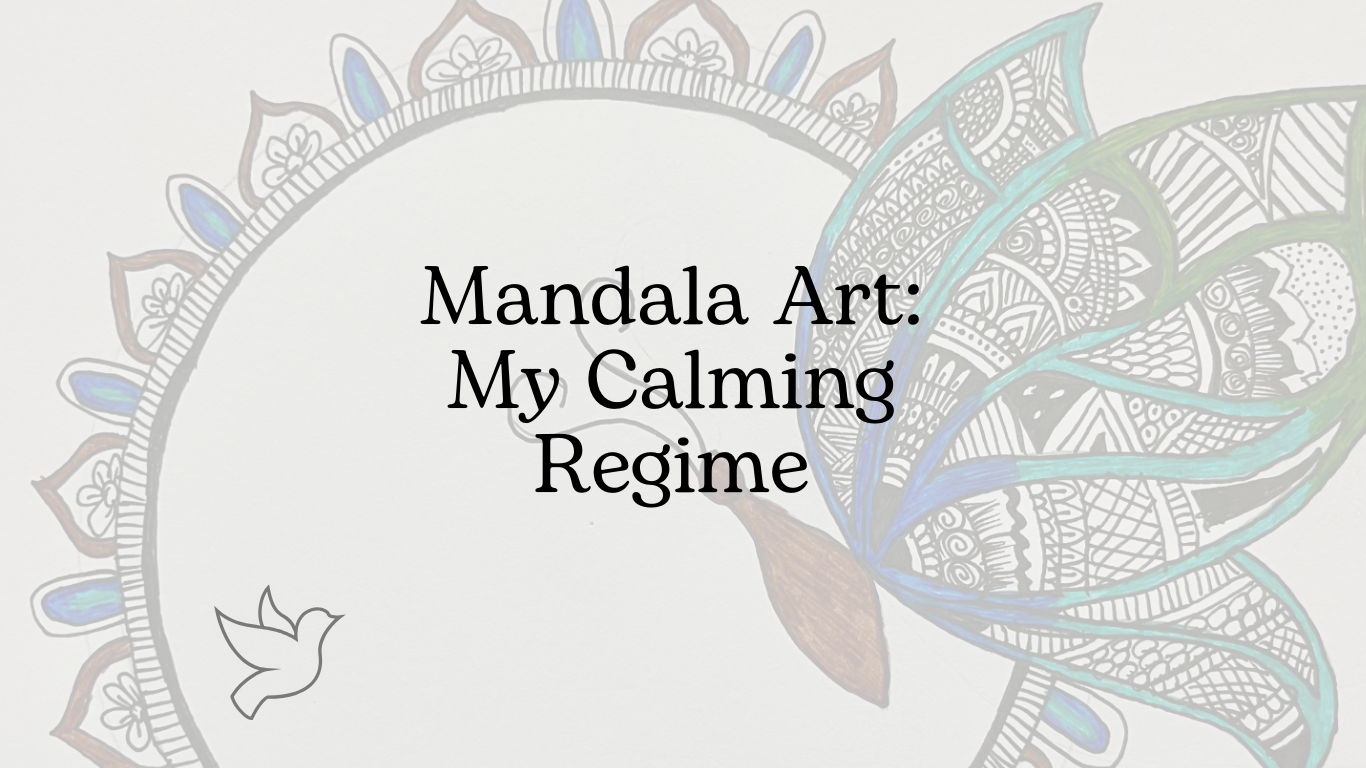
While exploring these mental well-being techniques, I landed on Mandala art, a technique that includes an intricate set of strokes and curves using thin markers to display a beautiful piece of art that looks aesthetically traditional and elegant. Mandala art is a skill that needs constant focus, dedication, and practice which makes it perfect for a peaceful regime. Here are my observations of the process while I am engrossed in a serious mandala art regime:
A State of Focus:
Mandala art expects your full focus when you are working on it. A small distraction might end up damaging a part of your art. By continuously practicing Mandala art, one can enjoy a deep state of focus that helps you carry forward this state in other forms of activities too.
How it helps with Anxiety: My observation with anxiety is that it never allows you to focus on the task at hand. With Mandala art, you are bringing your conscious state to focus on each stroke/line that you are designing which will help you cultivate a habit of focusing on the task at hand.
Being in the present:
A major advantage of Mandala art practice is that it helps you stay in the present, with the art. While you are designing, you are planning the layout, and making the calculations in your head. And in some types of Mandala art, you have to design the elements to be equidistant from each other, hence, one mistake might compromise the entire art, so you are completely in the present, thinking of only the art.
How it helps with Anxiety: One of the causes of an anxious brain is not being in the present, and an anxious brain doesn’t allow it to be in the present, basically a vicious cycle. Hence, with Mandala art, you are cultivating a habit of being in the present. With consistency, you may develop a conscious habit of bringing your mind back to the present and observing things that are happening around you.
Time to Introspect:
I mostly prefer my mandala art time especially when I feel in a confused state with lots happening in my head and just need a calm space. While I am engrossed in my art, I feel like I am having an interaction with my mind. It throws some delirious thoughts on my face and I can feel myself drifting away into this black hole of thoughts. However, the process of mandala art throws me back to reality forcing me to observe these thoughts and the root cause of it. By repeatedly doing so, I am able to rationalize my thoughts in a saner way.
How it helps with Anxiety: As mentioned above, Anxiety’s part of the job is to throw you into the black hole of erratic thoughts. By practicing a mandala art routine, you may find a way to introspect and dissect these thoughts to make them make sense.
Conclusion
Believe it or not, there was a time when I used to see a Mandala art and my mind literally tried to snap me away from it. It used to make me feel that Mandala art is the most complicated form of art and I could never do it. For most part of the time, I had decided to never even attempt doing it for the fear that it would shatter my confidence completely. However, my second sketch was proof that there is a light at the end of this tunnel. Guess what? There was! All I can say is that I have hope in Mandala art, because, I almost gave up on it but it didn’t. Here are some of my sketches:


Leave a Reply